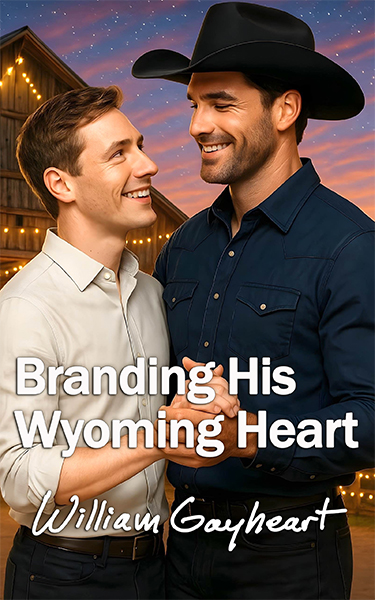
Branding His Wyoming Heart
Buy the Book
You can purchase the book from your favorite online store.
Select a StorePlus you can request this book from your local library.
He came to Wyoming to fulfill a promise. He stayed because he found his future.
Ambitious marketing exec Owen Beckett lives for his meticulously planned career. But a deathbed promise lands him at the remote Lazy M Ranch, and into the world of Caleb McIntyre—a rugged, third-generation rancher whose quiet strength challenges Owen’s carefully constructed life.
As Owen uses his city smarts to help save the struggling ranch, undeniable chemistry ignites. But when Owen’s dream promotion calls him back to Chicago, he faces an impossible choice: the career he’s tirelessly built, or the man offering a love that redefines success itself.
Branding His Wyoming Heart is a contemporary gay instalove romance featuring opposites attract chemistry, small-town charm, and the fish-out-of-water journey of a city boy discovering that sometimes the best investment is a matter of the heart.
Fast Facts
- Pairing
- Rancher x marketing exec
- Tropes
- Opposites attract, instalove, small town
- Formats
- Ebook, Paperback, Audiobook , 27 thousand words
Read Chapter 1
Owen
The GPS told me to turn right onto an unmarked dirt road, which seemed wrong on multiple levels. I slowed my rental car, a compact that the agency had assured me would be “perfectly adequate for Wyoming,” its engine whining slightly in protest, and peered through the windshield.
What appeared to be little more than a trail disappeared into rolling green hills under a sky rapidly turning the color of slate. The air, even through the closed vents, smelled different here. Dusty, tinged with pine and the scent of impending rain, a world away from Chicago’s filtered cityscape.
“You have arrived at your destination,” the robotic voice announced with unearned confidence.
“I most certainly have not.”
I squinted. Then I saw it. A weathered wooden sign, half-hidden by overgrown sagebrush, proclaiming “Lazy M Ranch—Est. 1923.”
So this was it. The place my grandmother had made me promise to visit.
A sudden, sharp memory surfaced.
Nana Eleanor, frail in her hospital bed but her eyes alight, talking about this ranch. “It’s magic, Owen,” she’d whispered, her hand gripping mine with surprising strength, her face etched with a longing I hadn’t understood then. “You feel it the moment you see the sign.”
The memory brought a fresh wave of grief, an ache behind my ribs that momentarily overshadowed everything else. I tapped my fingers against the steering wheel. In an effort to push the emotion down, I mentally reviewed the pitch deck I’d been finalizing when I should have been packing for this trip.
Two weeks in rural Wyoming was not my idea of a vacation, especially not now. The director of marketing position at Pinnacle Innovations, the promotion I’d strategically positioned myself for over three years, had finally opened up. It was within reach, tangible.
Yet here I was, driving into the middle of nowhere because I couldn’t say no to my grandmother, not even from beyond the grave. The weight of that last promise, made when her voice was already thin but insistent, pressed down harder than any client deadline.
As I continued driving, my phone buzzed with an email notification. I glanced down. Leslie, my assistant, forwarding client feedback on our latest campaign. Engagement metrics trending upward, as I’d predicted. The familiar itch to analyze and respond immediately was strong, but the narrow road offered no shoulder, only steep ditches choked with weeds.
“Two weeks,” I reminded myself. “You promised Nana two weeks.”
Six months had passed since her funeral, but the grief still ambushed me like this, sudden and fierce. She was the only one who ever really saw me, who didn’t measure my worth in quarterly results and accolades like the rest of my high-achieving family. “Martha is the dearest friend I’ve ever had,” she’d insisted. “And that ranch—it’s magic. Promise me you’ll go. Just once.” I’d promised and I wouldn’t break it.
The car lurched as the wheels hit a deep rut. I cursed under my breath as raindrops began spattering the windshield. Of course it would rain. The “light showers” forecasted looked heavier than my weather app had predicted.
Five minutes later, the skies had opened completely. The windshield wipers, frantically swishing, couldn’t keep pace with the deluge. Visibility dropped to near zero. The path ahead dissolved into a brown, churning mess. The compact shuddered, the tires spinning with a sickening, high-pitched whine as they lost traction.
“No, no, no.” I pumped the brakes gently, heart hammering against my ribs. What were you supposed to do when sliding in mud? Accelerate? Decelerate? Turn into the skid?
None of the options felt right as the vehicle slowed to a dead stop, wheels spinning uselessly in what was rapidly becoming a mud pit. Helplessness washed over me, cold and infuriating. A top performer, stuck like a city-boy cliché.
I put the car in park and let my forehead drop to the steering wheel with a groan. Through the rain-streaked windows, I could just make out the vague outline of buildings in the distance, maybe half a mile away, but it might as well have been on the moon in this downpour.
A sharp knock on my driver’s side window nearly made me jump out of my skin. I turned, startled, to see a tall, broad-shouldered figure looming beside the car. Rain streamed off the brim of his cowboy hat, plastering dark hair to his temples. Fantastic. My first authentic cowboy encounter, and I was mired in mud, utterly failing at basic navigation.
I rolled down the window a crack, rain immediately misting my face. “Hi, I’m—”
“Stuck,” he finished for me, his voice calm but edged with irritation or, perhaps, resignation. His blue eyes, startlingly direct, assessed the situation in a single, swift glance. “You must be Martha’s visitor. You should’ve called from the main road. This one gets treacherous in the rain.” His tone made it sound like rudimentary knowledge, although I’d never set foot in Wyoming before today.
“The GPS—” I began.
“GPS doesn’t know this land.” He sighed, a plume of breath visible in the cool, damp air. Rain dripped from his stubbled jaw. “Stay put. I’ll get the truck.”
He turned and splashed away before I could respond, his long strides eating up the distance despite the sucking mud. I watched him go, noting the confident set of his shoulders beneath a rain-darkened plaid shirt and the way his worn jeans fit him just right. The clothes were a stark contrast to the tailored suits I was used to seeing. Something about his retreating figure made my pulse quicken, a flicker of unexpected awareness I quickly blamed on the stress of the situation.
True to his word, a mud-splattered pickup truck appeared minutes later. He worked efficiently, hooking up a chain to my rental’s frame with practiced ease and pulling it free with minimal fuss. Once my car was on slightly more solid ground, he gestured for me to follow him and drove slowly ahead, navigating the slick track with an expertise that highlighted my incompetence.
I trailed behind his truck, mortified and annoyed in equal measure. Not the first impression I’d hoped to make, though truthfully, I had given little thought to impressions at all. This was an obligation-fulfillment trip, scheduled precisely between the Thornton Media campaign wrap-up and the impending quarter-end push.
A necessary pause, nothing more.
The ranch house came into view as we crested a small hill. It was larger than I’d expected, a sprawling two-story structure with a wide, welcoming porch and a sturdy stone chimney puffing a thin ribbon of smoke into the rain-heavy air. Several outbuildings and what looked like stables completed the picture-perfect ranch scene. Under different circumstances, say, scouting for a lifestyle brand’s western-themed campaign, I might have appreciated its rustic charm.
My cowboy rescuer parked his truck and was opening my car door before I’d even shifted into park.
Up close, he was even more imposing, easily over six feet tall, with the kind of authentic tan earned from actual outdoor work, not sun beds, or a sprayed on “glow-up” from a salon. His eyes, that precise, arresting blue, like the logos of successful financial services firms, met mine briefly. Trustworthy and strong, my marketing brain cataloged automatically, though his expression remained unreadable beneath his hat brim.
“I’ll grab your bags.” He nodded towards the house. “Martha’s waiting on the porch.”
I squinted through the rain and made out an elderly woman waving enthusiastically from the shelter of the covered porch. Taking a deep breath, I stepped out of the car and immediately sank ankle-deep in mud.
Perfect. Just perfect. My pristine white Nike sneakers disappeared into brown sludge with a horrifying, sucking squelch.
“Oh honey, look at you!” the woman I assumed was Martha called out, her voice warm and carrying easily over the rain. “You’re soaked through! Come inside right away!”
I sloshed my way toward the house. Each step produced an embarrassing suction noise against the drumming rain. The cowboy followed with my luggage, somehow avoiding the worst of the mud puddles with an ease born of familiarity.
“You must be Owen,” Martha said when I reached the porch, her bright eyes crinkling at the corners as she smiled. She was shorter than me by several inches, with silver hair cut in a practical bob. “Eleanor’s grandson. Oh my, you have her eyes!”
Before I could respond, she pulled me into a hug that smelled overwhelmingly of cinnamon and lavender. The scent, the warmth of her embrace, it reminded me so powerfully of my grandmother that my throat tightened almost painfully.
“Thank you for having me.” I pulled back, forcing what I hoped was a gracious smile. “I’m sorry about the dramatic arrival.”
“Nonsense! A little mud never hurt anyone.” She turned to the cowboy who was setting my bags down just inside the door. “Caleb, thank you for rescuing our guest. Why don’t you go get dried off while I show Owen to his room?”
So my rescuer had a name. Caleb. He nodded at Martha, then turned those startlingly blue eyes to me. “Welcome to Lazy M. Watch out for the mud.” His mouth twitched, not quite a smile, but close, before he turned and headed back out into the rain toward one of the outbuildings. I caught myself watching the way his shoulders moved under his wet shirt again before snapping my attention back to Martha.
“Don’t mind him.” Martha ushered me inside with a comforting hand on my arm. “Caleb’s a good man, but he takes a while to warm up to new folks. Been under a lot of pressure lately, with the ranch and all.”
The interior of the house welcomed me with the comforting scent of baking bread. Hardwood floors gleamed beneath colorful hand-woven rugs. The furniture looked genuinely lived in and comfortable. It was a world away from the carefully curated, minimalist pieces in my Chicago condo. Photos lined the walls, generations captured in black and white and fading color, telling a silent story of time’s passage on this land.
“I’ve put you in the blue room upstairs.” Martha led me through a cozy living room towards the staircase. “It has the best view of the mountains when the weather clears. The bathroom’s just across the hall. Why don’t you get changed into something dry, and I’ll put on some coffee?”
“That sounds wonderful.” Suddenly aware of how chilled I’d become, goosebumps rising on my arms despite the house’s warmth.
The blue room was aptly named, with pale blue walls and a handmade quilt in varying shades of blue and white spread across the queen-sized bed. An antique dresser stood against one wall, its wood dark and rich. A cushioned window seat looked out over what I imagined would be a spectacular view, currently obscured by sheets of rain. Nothing matched perfectly, unlike my apartment, where every object was chosen for aesthetic cohesion. Everything here seemed to belong together, though, creating a sense of harmony I found unpretentious and utterly charming.
After a hot shower and changing into dry jeans and a sweater, I felt marginally more human. I checked my phone. No service, of course. Once I found Wi-Fi, I’d need to respond to the emails Leslie had forwarded. My boss had approved this “vacation” on the condition I remained available for major issues.
“There he is!” Martha exclaimed when I came downstairs. “Feel better? Come sit in the kitchen. Coffee’s ready, and I’ve just taken a batch of scones out of the oven.”
The kitchen was clearly the heart of the house, spacious and well-used, dominated by a large wooden table that could easily seat eight. Copper pots hung from a rack over a central island scarred with knife marks and history. The aroma of freshly baked goods was intoxicating. If Pinnacle’s food industry clients could bottle this exact scent, they’d double their sales overnight.
“This is lovely.” I accepted a mug of coffee that smelled a hundred times better than the premium single-origin brew I paid nine dollars for back home. “Your home is beautiful.”
Martha laughed, a warm, genuine sound that filled the room. “Oh, it’s not mine, dear. It belongs to the McIntyres, has for three generations now. I just live in the guesthouse out back. Have for almost thirty years, since my Harold passed. James, that’s Caleb’s father, lets me stay on and help with the cooking and such.”
I blinked, recalibrating. “I’m sorry, I assumed... my grandmother said I’d be staying with you.”
“And so you are.” Martha beamed. “Just not in my little cottage. It barely has room for me and my knitting supplies. No, the McIntyres always open their home to visitors. They’re good people.”
I took a sip of coffee, hiding my slight discomfort at being an unexpected houseguest. “That’s very generous of them.”
“Nonsense. It’s the ranch way. Besides, we don’t get many visitors out here these days, not since they built that fancy resort over in Jackson.” She waved a hand dismissively. “All infinity pools and cucumber water. Not a real horse in sight, I wager.”
Over the next hour, prompted by my questions, Martha gave me a condensed history of the Lazy M Ranch, from its founding by Caleb’s grandfather Maxwell McIntyre—hence the “M”—to its current operations. I learned they primarily raised cattle but also kept horses, grew hay, and had recently started offering guided trail rides to supplement their income.
“The ranching business isn’t what it used to be,” Martha explained, her expression growing serious. “Costs keep rising, but prices don’t always follow. Most small family ranches around here have been bought up by corporations or wealthy city folks wanting a country playground.”
The sound of boots scraping mud off on the back porch interrupted us. A moment later, Caleb walked in, now dry and wearing fresh clothes, though still crowned with the ubiquitous cowboy hat. His presence seemed to fill the kitchen, commanding attention without effort.
“Just telling Owen about the ranch,” Martha said cheerfully. “And I was about to mention the centennial coming up.”
“Centennial?” I set my mug down, grateful for the change in subject away from potential financial strain.
Caleb leaned against the counter, pouring himself coffee from the pot. “Town of Meadow Creek turns one hundred next month. Big celebration planned. Every business and ranch in the area is taking part.”
“It’s quite the event,” Martha added, her eyes bright with excitement. “Parade, rodeo, craft fair, historical exhibitions. The Lazy M is hosting a special cattle drive demonstration and barn dance.”
“Sounds like a great opportunity for local tourism.” My marketing brain clicked into gear. “Are you doing any special promotion for it?”
Caleb’s eyebrows rose slightly. “Flyers at the general store and a mention in the county paper.”
I bit my tongue, stopping myself from pointing out how woefully insufficient that was.
In Chicago, we’d have developed a comprehensive multi-channel strategy with targeted digital ads, influencer partnerships, an optimized landing page, PR outreach.
Not my ranch, not my problem, I reminded myself.
But a flicker of something else sparked too, a thought that they were missing an enormous opportunity, fueled perhaps by a nascent desire to help this place tied to Nana. I hesitated, wondering if I should say something. Would it be perceived as helpful or condescending?
Martha, however, seized on my initial comment. “Owen works in marketing in Chicago. Big important company, isn’t that right?”
“Pinnacle Innovations. We specialize in brand development and digital marketing strategies for companies looking to increase market share and customer engagement.”
“Fancy,” Caleb said. The single word carried a tone I couldn’t quite interpret, somewhere between impressed and deeply skeptical.
Just then, an older man appeared in the doorway, his resemblance to Caleb unmistakable despite his gray hair and more weathered features. “Thought I heard voices. You must be Eleanor’s grandson.”
I stood to shake his offered hand. “Owen Beckett. Thank you for having me in your home, Mr. McIntyre.”
“James, please. Any grandson of Eleanor’s is welcome here. Martha hasn’t stopped talking about your visit for weeks.” His smile was warmer, more open than his son’s. He pressed his other hand against his chest as he spoke, a fleeting gesture, perhaps habitual, hinting at Martha’s earlier mention of pressure.
“How was the drive in?” James asked, settling into a chair at the table.
“Eventful.” I smiled sheepishly. “Your son had to rescue me from the mud.”
“City cars,” James chuckled good-naturedly. “Not built for ranch roads, especially in weather like this.”
“Neither are city shoes,” I admitted, glancing down at my mud-caked sneakers abandoned by the door.
Caleb’s mouth quirked into what might almost have been a genuine smile this time.
* * *Dinner that evening was a surprisingly lively affair. James turned out to be a natural storyteller, sharing tales of ranch life—blizzards, calving mishaps, close calls with wildlife—that painted a vivid picture of a world completely foreign yet captivating to me.
Martha kept the conversation flowing smoothly, asking about Chicago and my job. Even Caleb contributed occasionally, his observations brief but insightful, though he remained more reserved than his father.
I laughed more than I had in months, the constant thrum of quarterly projections and client acquisition strategies fading into the background. The food—hearty beef stew thick with vegetables served with warm, crusty homemade biscuits—put my usual rotation of expensive takeout salads and rushed sushi to shame. This meal was different, slower and more connected.
When the conversation inevitably turned back to the upcoming centennial, I listened with growing professional interest, despite my earlier resolution. It was clearly a major event for the community, holding potential for significant regional exposure.
“Problem is getting people to come all the way out here instead of just hitting the events in town.” James shook his head. “Used to be folks were curious about real ranch life. Now they’d rather stay at that resort with its pool and spa treatments.”
“What exactly are you offering at your event?” I asked, unable to fully suppress my professional curiosity.
“Authentic ranch experience,” Caleb replied, his deep voice commanding attention even when speaking softly. “Cattle drive demonstration, horseback riding, barbecue, barn dance with a local band.”
“That sounds wonderful.” I meant it sincerely. I chose my words carefully, wanting to be helpful, not critical. “Have you considered highlighting the authentic experience angle in your marketing? Many tourists, especially younger demographics, are looking for genuine cultural experiences rather than manufactured entertainment. It’s one of the fastest-growing segments in the experiential tourism market.” I paused. “Sorry. Occupational hazard. I see marketing opportunities everywhere.”
The table fell silent for a beat, and I held my breath, worried I’d overstepped.
To my relief, James looked thoughtful rather than offended. “No need to apologize, Owen. It’s a good point. We’re just not sure how to reach those kinds of tourists.”
“Social media could be powerful. Especially visual platforms like Instagram and TikTok. You could showcase the incredible beauty of the ranch itself. People go crazy for authentic western content these days. Cowboy culture is trending big time.”
Martha’s eyes lit up. “That’s a wonderful idea! Isn’t it, Caleb?”
Caleb looked less convinced, though not entirely dismissive. “We’re not exactly social media types.”
Our eyes met across the table. For a brief moment, I saw something beyond skepticism in his gaze. Was it a flicker of interest, maybe even grudging respect?
“You don’t have to be,” I assured him, warming to the subject despite myself. “It’s about sharing what you already do. The stunning landscapes, the animals, the daily ranch life that might seem ordinary to you but is fascinating to others. Beautiful photography of your land at sunset, short videos of cattle drives or horse training. The algorithms love that kind of content.”
The conversation shifted to other topics after that, but I could tell that James, at least, was considering my suggestions. After helping clear the dishes, I excused myself, explaining I needed to check emails now that I had the Wi-Fi info. At least the wireless was strong even if the cell service was spotty.
As I passed a room off the main hall, what looked like a study, I overheard voices, low and tense. Caleb and his father.
“The bank won’t extend the loan.” Caleb’s voice was tight with frustration. “Not without more collateral, which we don’t have.”
“There has to be another way,” James replied, his voice weary. “This ranch has survived worse.”
“Not with operating costs this high and beef prices this low. The centennial event might bring in some cash, but nowhere near what we need to keep going through winter.”
I hurried past, feeling like an intruder. Their words echoed in my mind as I stood by the window seat in my room, holding my phone high, trying fruitlessly to conjure a signal bar. The ranch was in financial trouble, serious trouble, from the sound of it.
When I crawled into bed, exhausted but wired, I stared at the ceiling. The soft handmade quilt felt nothing like my high-thread-count Egyptian cotton sheets at home, yet it was more comforting.
Through the partially open window, the unfamiliar night sounds of the countryside drifted in—the rhythmic chirping of crickets, the soft whisper of wind through trees. So different from Chicago’s constant urban hum of traffic, sirens, and distant trains.
Somewhere, a coyote howled, a lonely, wild sound answered moments later by another.
Staring into the darkness, listening to a world utterly unlike my own, I wondered if this unexpected detour might be about more than just fulfilling an obligation.
Wondering if two weeks might be just enough time to help save a piece of my grandmother’s past.