Their Four Date Experiment
Buy the Book
Buy direct from me on Curios. Ebooks can be downloaded directly, or sent to BookFunnel as well as Kindle, Kobo, and Nook devices.
You can purchase the book from your favorite online store.
Select a StorePlus you can request this book from your local library.
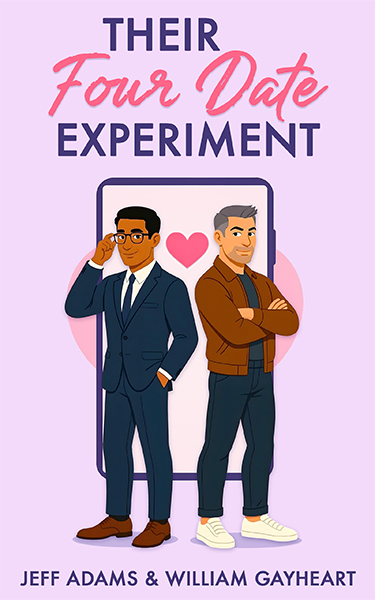
What happens when a tech-skeptic journalist meets the algorithm designer who might be his perfect match?
Journalist Theo Barrett is determined to expose the dangers of algorithmic dating after watching his parents’ marriage crumble because of it. His latest target is LoveLogic, the cutting-edge company promising data-driven relationship success.
When a confrontation with the company’s founder, Zach Mendez, goes viral, Theo’s editor offers him an irresistible opportunity: participate in a series of dates with Mendez himself while documenting the experience. What begins as research slowly transforms as Theo discovers the wounded heart behind Zach’s brilliant mind—a man driven to prevent others from experiencing his own past betrayal.
As their connection deepens, Zach discovers a critical flaw in LoveLogic’s algorithm that has been inflating their compatibility score. Now both men must choose between professional integrity and the relationship that’s challenging everything they believe about technology and human connection.
If the algorithm that brought them together is flawed, does that make their feelings any less real?
Their Four Date Experiment is a steamy, emotional, opposites attract romance, featuring professional rivals and the undeniable chemistry that happens when two stubborn men discover their greatest challenge just might lead to their HEA.
Fast Facts
- Co-author
- Jeff Adams
- Pairing
- Journalist and tech CEO
- Tropes
- Opposites attract, Dating in public, Rivals-to-lovers
- Formats
- Ebook, Audiobook, Paperback, Hardback , 52 thousand words
Read Chapter 1
Theo
Zach Mendez strode onto the stage for his keynote at the ConnectSphere Expo. His presence was impossible to ignore—the crisp navy suit perfectly tailored, the precisely trimmed black hair, the designer glasses catching the light as he adjusted them with a practiced, almost too-smooth gesture.
A hush fell over the audience of tech devotees and industry insiders. He took his position center stage, a sleek confidence radiating from every movement.
A confidence that grated on me instantly.
“Love isn’t a mystery anymore.” His voice was warm and assured, designed to charm. “It’s a science.”
My pen pressed harder against my notepad, nearly tearing the page. Of course, that would be his opening line. Pure tech messiah arrogance.
The massive screen behind him illuminated with colorful graphs and statistics—LoveLogic’s latest success metrics. Ninety-four percent satisfaction rate. Eighty-five percent of matches resulting in relationships lasting beyond six months. Seventy-eight percent reduction in time spent searching for compatible partners.
Numbers presented as gospel.
“We’ve mapped the emotional genome.” Mendez continued pacing with measured steps, a predator patrolling his territory. His control was absolute. “Our algorithm doesn’t just match people based on surface-level preferences. It predicts emotional compatibility through behavioral analysis and psychological mapping.”
The audience nodded along, rapt. A woman two seats down sighed, a soft, worshipful sound that made my skin crawl. I resisted the urge to roll my eyes.
I’d spent six months digging into dating algorithms for my exposé. The investigation included tracking the digital wreckage of broken relationships, as well as interviewing people who were reduced to data points and left feeling hollowed out from the experience. Six months observing companies like LoveLogic commodify the most fundamentally human of experiences while calling it progress.
This guy, Mendez, was the most polished evangelist I’d encountered yet. There was an intensity about him, though, different from the usual Silicon Valley hype men.
He moved into the technical portion, explaining improvements to their patented “emotional compatibility mapping.” His passion flared here—this wasn’t just corporate speak. His hands, previously controlled, gestured more freely when discussing the algorithm’s architecture, revealing the programmer beneath the CEO veneer.
The shift was subtle, but I noted it.
“We’ve increased predictive accuracy by seventeen percent this quarter alone.” Genuine excitement broke through his composed facade. “The pattern recognition component now identifies compatibility markers that even users themselves aren’t consciously aware of.”
My phone vibrated. Vivian, my editor.
Vivian: Is the tech messiah living up to the hype?
I typed back quickly.
Theo: Playing God with relationships and the crowd is eating it up. Q&A starting soon.
Her response was immediate.
Vivian: Remember, we need sound bites for the follow-up piece.
I slipped the phone into my pocket. Mendez was concluding with user testimonials—slickly produced video clips of attractive thirty-somethings gushing about how LoveLogic had found their perfect match.
The algorithm understood me better than I understood myself.
Love, optimized and sanitized.
“We’re not eliminating romance.” Mendez’s voice dropped to an intimate register that somehow made the cavernous hall seem small, personal. Everyone leaned forward. “We’re optimizing the path to meaningful connection in a world where time is our scarcest resource.”
A familiar tightness gripped my chest, sharp and sudden as memories surfaced. My father, clutching a printout from DateRight, his face alight with the certainty of “98% compatibility” with a woman twenty years younger. My mother, weeks later, her face pale against the pillow, the life seeming to drain out of her alongside her belief in thirty years of shared history.
This wasn’t just professional critique for me.
The moderator opened the floor for questions. Several hands shot up.
Not mine. Not yet.
Mendez handled softball queries about timelines and partnerships, his answers polished, precise, occasionally even charming. He deflected challenges with practiced ease.
When the fifth consecutive question about investment potential came up, I raised my hand. The moderator scanned the room, perhaps seeking variety, and pointed my way.
I stood, ensuring my press badge was visible as I moved toward the aisle microphone. Recognition flashed across Mendez’s face just before I spoke.
He knew who I was. Good.
“Theo Barrett, from The Fulcrum.” My voice amplified through the hall, steady despite the adrenaline beginning to pulse in my ears. “In your presentation, you mentioned ‘optimizing the path to meaningful connection,’ but isn’t there an inherent contradiction in reducing human emotions to data points?”
Mendez’s posture straightened almost imperceptibly. The corner of his mouth twitched upward—not quite a smile, more like a boxer acknowledging an opponent stepping into the ring.
“Mr. Barrett. I’ve read your recent article.” He adjusted his glasses, a gesture I was starting to recognize as a thinking pause, a control mechanism. “There’s no contradiction when you understand that data doesn’t reduce emotions. It illuminates patterns we’re often blind to ourselves.”
“In my research,” I continued, gripping the microphone slightly tighter, “I interviewed dozens of people who felt dehumanized by algorithmic matching. One woman described feeling like ‘produce being sorted on an assembly line.’ How do you respond to concerns that systems like LoveLogic commodify what should be an organic human experience?”
A slight murmur passed through the audience. Mendez stepped closer to the edge of the stage, his focus all on me now, the polished CEO persona sharpening into something more intense.
“I’d respond that before algorithms, people were already commodifying each other—judging on appearance, social status, first impressions that often led nowhere.” His voice remained measured, but a fire burned behind his words. The programmer defending his creation. “LoveLogic counteracts superficial sorting by highlighting compatibility factors people might otherwise overlook.”
“But doesn’t outsourcing our romantic choices to an algorithm diminish what makes human connection meaningful in the first place? The serendipity, the risk, the choice?”
“We’re not outsourcing choice.” A flash of genuine frustration crossed his face before being controlled. “We’re providing information. Better information than randomly bumping into someone at a coffee shop and mistaking physical attraction for compatibility.”
I pressed harder, sensing the crack. “Your marketing materials claim ‘LoveLogic understands you better than you understand yourself.’ Isn’t that explicitly encouraging people to trust an algorithm over their own instincts?”
The audience was fully engaged now, heads swiveling between us like spectators at a tennis match.
Mendez abandoned his position near the podium, moving to the edge of the stage, just ten feet from where I stood.
“Our algorithm processes thousands of behavioral data points that reveal patterns beyond conscious awareness.” His professional polish fractured again, allowing the passionate developer to slip out. “Would you refuse an X-ray because it sees things you can’t? Knowledge doesn’t eliminate choice—it informs it.”
“Knowledge isn’t neutral when it’s filtered through proprietary algorithms no one can examine. You’re asking people to trust a black box with their emotional lives, based on data harvested through increasingly invasive means.”
His eyes narrowed. “And you’re romanticizing a status quo where people waste years in incompatible relationships because they trusted ‘gut feelings’ over objective compatibility assessment.”
The moderator stepped forward, clearly sensing the escalating tension. “Perhaps we should move to the next question—”
Mendez held up his hand, a gesture of command that silenced the moderator.
“No, this is important.” He looked directly at me, the audience forgotten. “Mr. Barrett, in your article, you characterized algorithmic matching as ‘the death of authentic love.’ But what’s your alternative? Returning to a world where people make life-altering relationship decisions based on limited information and cognitive biases?”
“My alternative is that human connection isn’t a problem technology needs to solve.” My voice rang with conviction, fueled by more than professional skepticism. “The messiness, the uncertainty—that’s not a bug in the system. It’s a fundamental feature of authentic connection.”
Mendez’s expression shifted subtly—something unreadable flickered there, curiosity mixing with the frustration. “That’s a lovely sentiment, but it doesn’t explain why millions of people voluntarily use our service to find partners they might never have met otherwise.”
“People also voluntarily use gambling apps designed to be addictive. Popularity doesn’t equal ethics.”
A ripple of uncomfortable laughter moved through the audience. Mendez’s jaw tightened for a moment, then relaxed into an unexpected, almost challenging smile.
“Technology has always changed how humans connect, Mr. Barrett. From written language to telephones to dating apps. Each innovation was resisted by those who romanticized whatever came before.” He spread his hands, reclaiming his stage presence. “I’m not claiming our algorithm is perfect, but we’re using science to solve real problems of connection in an increasingly isolated society.”
The moderator stepped in again, more firmly this time. “We do need to move on to other questions.”
I nodded, relinquishing the microphone and returning to my seat, pulse pounding in my ears. On stage, Mendez smoothly transitioned to the next question. He regained his composure, but his eyes flicked toward me several times during his response.
He knew this wasn’t over.
My phone buzzed.
Vivian: Watching the livestream. That was GOLD. Call me when it’s over.
As the session concluded, I was aware of glances from nearby attendees. The conference schedule listed a networking reception next, where Mendez would no doubt be swarmed.
I hung back, observing from the periphery as he worked the room. Up close, away from the spotlight, smaller details emerged. The way he checked a vintage watch rather than his phone. How he listened with complete focus to whoever spoke to him. The intelligent intensity in his eyes as he discussed technical aspects with fellow developers.
There was something undeniably human about him in this setting, something his polished stage presence couldn’t fully convey. Something that complicated the easy villain narrative I’d started building.
My phone rang. I stepped into a quiet hallway to answer.
“That confrontation is already trending,” Vivian said without preamble. “The video clip hit fifty thousand views in twenty minutes.”
“He’s exactly what I expected.” I glanced back toward the reception. “Brilliant, but detached from the human cost of what he’s building.”
The words felt less certain than they had an hour ago.
“The human cost is what we need to focus on for your book.” Vivian’s voice sharpened. “LoveLogic is the perfect case study—the most sophisticated algorithm with the most charismatic founder.”
I watched as Mendez excused himself from a circle of admirers, stepping away to check something on his phone. For a brief moment, when no one was watching him, his confident posture relaxed. He pinched the bridge of his nose beneath his glasses, looking suddenly, profoundly tired.
“I want to dig deeper.” My intensity surprised me. “Beyond the public confrontations. I need to understand what makes someone believe they can reduce love to an equation. What drives someone like him?”
“That’s exactly what I wanted to hear,” Vivian replied. “This could be the centerpiece of your manuscript. The philosophy behind the algorithm, direct from the source.”
“I doubt Mendez will grant me an interview after today.”
“Never underestimate the power of controversy. You clearly got under his skin.” She paused. “And from what I could see, he got under yours, too.”
I frowned. “What’s that supposed to mean?”
“Just that there’s nothing better for research than a passionate intellectual adversary.” Vivian’s smile was audible. “Get back to me with a plan for deeper coverage on LoveLogic. Your manuscript deadline isn’t moving.”
We ended the call, and I turned back toward the reception hall. Through the doorway, I caught sight of Mendez again. Someone had made him laugh—a genuine, unguarded expression that transformed his features.
Then, as if sensing my gaze, he looked my direction. Our eyes met across the distance.
Neither of us smiled or nodded. For three long seconds, we held each other’s gaze, mutual recognition passing between us—intellectual adversaries sizing each other up across a battlefield of ideas.
I was the first to look away, turning toward the exit. This was just the beginning.